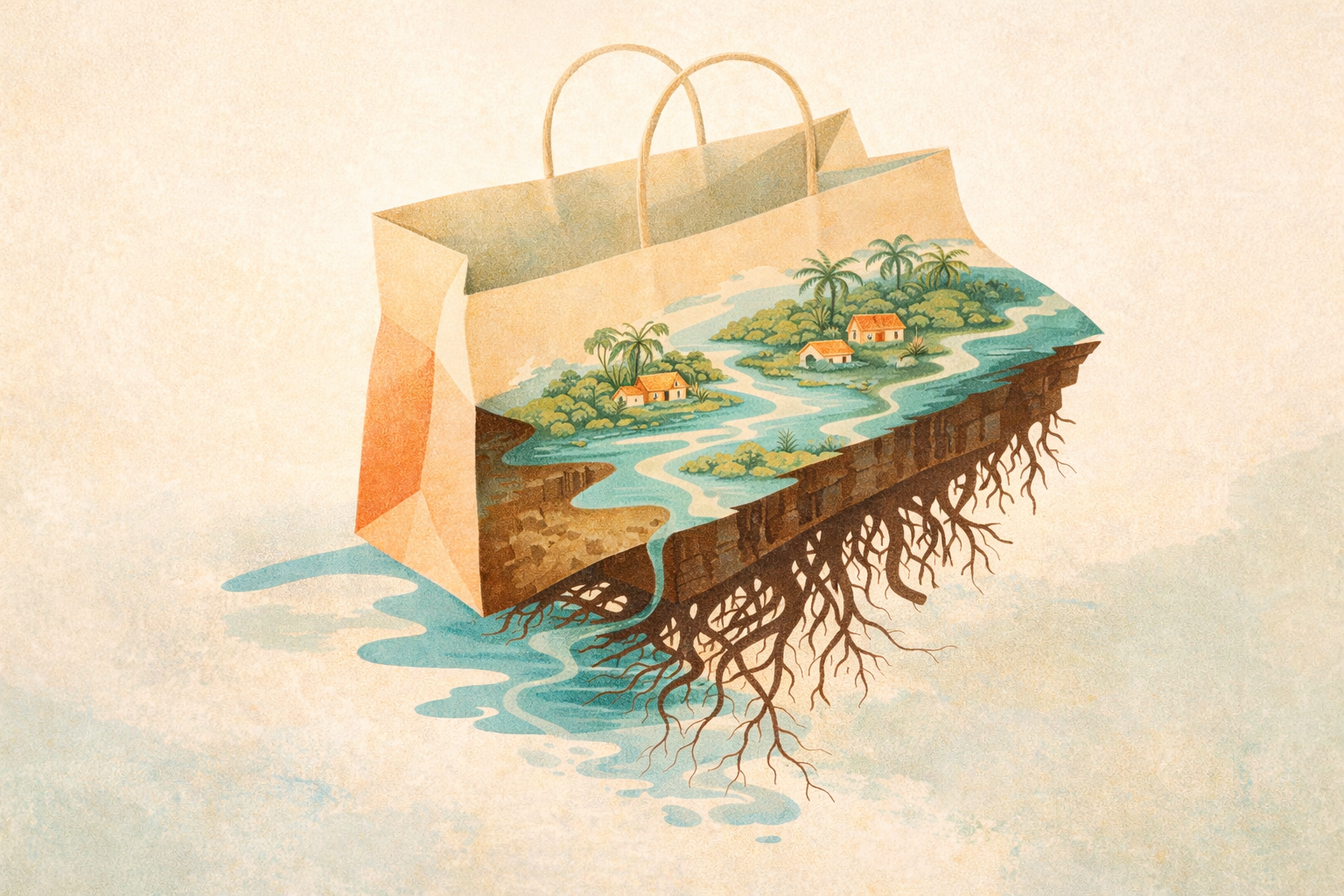
This was not development. It was dispossession
There is something morally revolting about taking Indigenous land in the twenty first century and routing the result into ordinary consumer paper. Not luxury goods. Not some remote industrial input. Tissue. Shopping bags. Food packaging. Magazines. Books. On Padang Island in Riau, a 2025 legal-sociological study in the Asian Journal of Law and Society examines what it explicitly calls a “notorious case of land grabbing,” centered on a 40,125-hectare acacia plantation concession linked to PT RAPP, a large-scale pulp and paper manufacturer, in an area where local people had long lived under customary systems of land control. The study’s conclusion is damning: customary rights may be acknowledged in principle at the national level, but in the field they remain vulnerable to being overridden by concession logic and state forest designations. That is not a bureaucratic technicality. It is a system for informing people that their history counts less than industrial paperwork.
The Akit People
One of the enduring scandals of land conflict is that the people most harmed are often made invisible before they are made politically disposable. A 2023 field study by Forest Peoples Programme found that Akit communities in these plantation areas had lost large parts of their customary territories without their prior rights being recognized and without free, prior, and informed consent. The harms the study records are not abstract. They include lost sago groves, farmlands, fisheries, hunting grounds, medicinal plants, and forest products; impeded access to sacred lakes; pollution from plantation runoff; and damage to traditional identity and religious practice. The same study stresses that the Akit retain a distinct belief system and a collective relationship to ancestral territory that links identity, subsistence, and land itself. In other words, this was not empty terrain awaiting productivity. It was a lived homeland.
The Akit dispossession story is older than this concession, which makes the repetition worse
This is not happening against a blank historical backdrop. In Indonesia, colonial and postcolonial land regimes repeatedly weakened customary control by empowering the state to treat lands without formal proof as state domain. The Dutch colonial regime systematically eroded communal customary rights, and those legal habits continue to shape land governance. So when Indigenous and customary communities are told today that their rights are incomplete because they do not fit the state’s preferred forms of proof, the injury is not merely current. It is cumulative. The Akit and other long resident communities are being asked, yet again, to bear the cost of somebody else’s paper system. That is why the language of sustainability can become so grotesque in these cases. There is nothing ethical about a modern supply chain that still depends on old habits of Indigenous dispossession.

Padang Island was not empty land
Rainforest and peat destruction
The environmental dimension of the Padang Island makes matters worse. A peer-reviewed study on recurrent peat fires there found that the island suffered severe peat ecosystem degradation and livelihood damage, and argued that the problem cannot be understood apart from social and political context. The researchers found that global demand for agricultural commodities drove massive peat drainage for monoculture on peatlands, creating livelihood vulnerability and ecological decline. Another recent peer-reviewed study on sago in Indonesia makes the contrast especially stark: sago can thrive on undrained peatlands and can support peatland restoration, whereas drainage-based plantation models bring oxidation, emissions, and fire risk. So the moral picture is not simply that one land use replaced another. It is that an Indigenous-linked landscape economy tied to sago and customary territory was subordinated to an industrial model that denies rights and contributes to global warming.
Ethically contaminated products
PT RAPP says its pulp and paper reach consumers through tissue paper, shopping bags, food packaging, magazines, books, and beverage packaging used by millions of people. Reuters reported that the company invested billions in additional paperboard capacity to meet rising demand for supposedly environmentally friendly packaging, even as they remained among plantation firms criticized for rampant land clearing and linked in public debate to recurring fire and peat controversies. That contrast should unsettle anyone who cares about the moral meaning of a supply chain. The question is not whether every finished paper product carries a neat line back to one contested plot of land. It is whether a commercial system can market ordinary paper as modern, convenient, and even green while unresolved Indigenous land claims remain buried under the fiber economy that feeds it. On Padang Island, the answer is disturbingly clear.
Akit land, memory, and subsistence were treated as obstacles to industrial profit. And no sustainability branding can sanitize it.


Leave a Reply