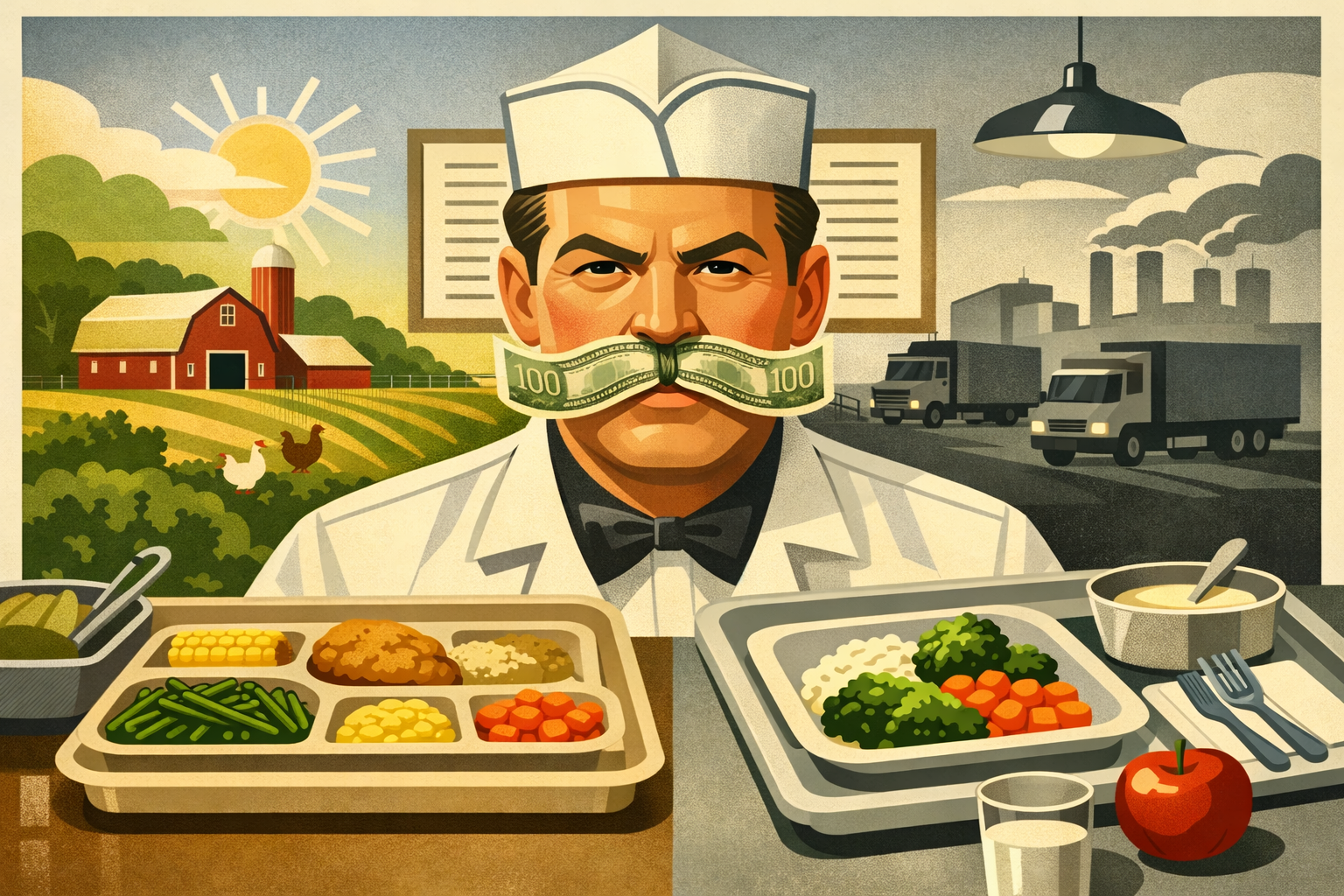
A public institution is a curious creature. It will say grace over stewardship, praise the family farm in a speech, and then spend the people’s money as if food grew in a spreadsheet and not in dirt. Yet these institutions are no trifle. The National School Lunch Program alone served more than 4.8 billion lunches in fiscal year 2024, at a cost of $17.7 billion. A buyer that large has the ability to positively impact public health and local economies.
The lowest bid is a very costly idol
We Americans have a touching faith in the lowest bid. We speak of it as if it descended from Sinai engraved on stone. But a low price is often only a high cost wearing a false mustache. Cornell researchers recently proposed an adjusted-bid tool for public food purchasing that accounts for local multiplier effects and added tax revenue, precisely because the sticker price alone can hide the true net cost. If a school or hospital buys from nearby farms, more of the money stays in workers, suppliers, tax receipts, and town life. If it buys by invoice only, it may save pennies and spend prosperity.
Schools have already shown the way
The best argument for this policy is that it has already stopped being a theory. USDA’s 2023 Farm to School Census found that 74.1 percent of school food authorities reported farm-to-school activity in school year 2022 to 2023, and those authorities estimated about $1.8 billion in local food spending. USDA also expanded the geographic preference option effective July 1, 2024, allowing child nutrition operators to use “locally grown,” “locally raised,” or “locally caught” as procurement specifications for unprocessed agricultural products. In reality, Washington has already admitted that public buyers may prefer nearness when nearness serves the public good. Yet we refuse to learn any lessons from that progress.

Hospitals ought to know better than most
Hospitals, of all institutions, should be the least willing to eat hypocrisy for supper. They exist to preserve life, yet too often buy food as though nutrition, resilience, and local economic health were somebody else’s department. A 2023 scoping review found that most studies it identified were from the United States, that 58 percent to 91 percent of U.S. hospitals in surveyed studies participated in local food procurement, and that the chief obstacles were limited reliable supply, kitchen constraints, and weak traceability systems. With procurement systems that are not half asleep, we could support fair trade AND improve the bottom line.
A serious country would make this ordinary
FAO has argued that local public procurement from family farmers can boost production, diversify diets, and generate inclusive growth. Brazil made the point in sterner fashion by requiring that at least 30 percent of school food procurement funds go to family farming. There is the lesson. If a nation wants small farmers to survive, it should not merely praise them in campaign season and abandon them in budget season. It should write them into the ordinary habits of public life: schools, hospitals, agencies, and institutions that eat every day and ought, by this late hour, to have learned that stewardship is not just a sentiment.


Leave a Reply