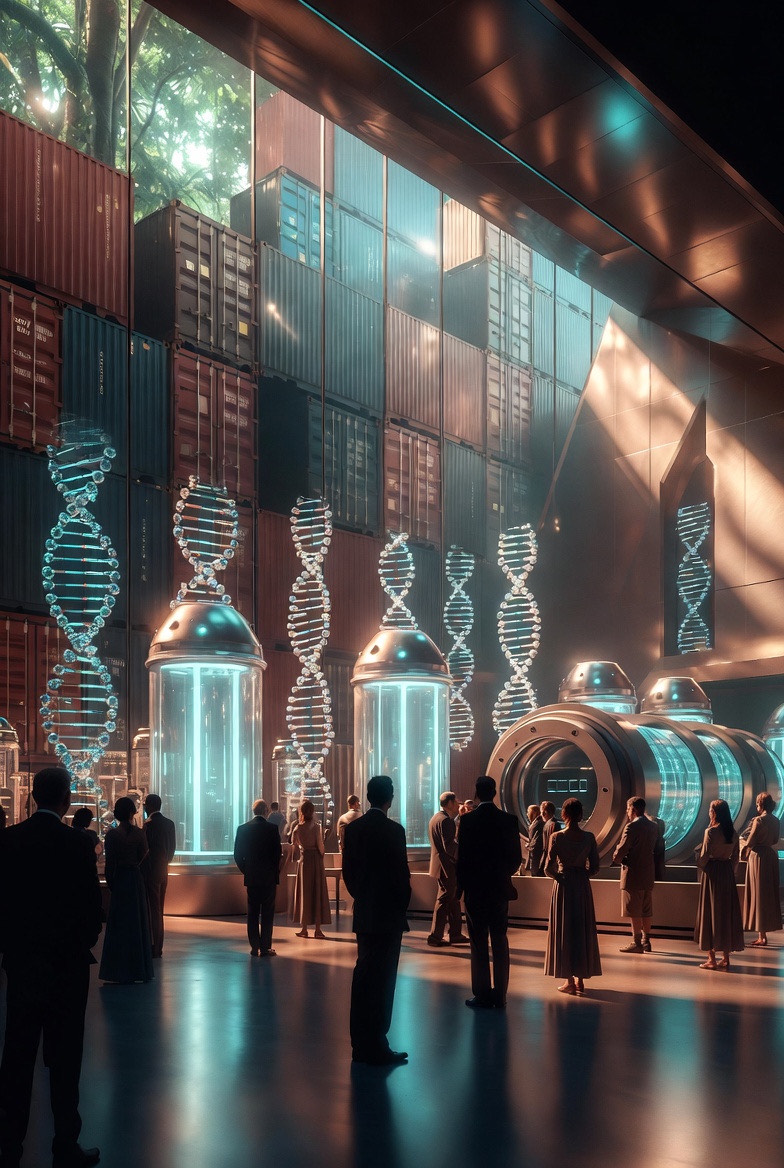
Dubai is giving biodiversity finance its glossy, mainstream moment. At the World Governments Summit 2026, the Museum of the Future is showcasing a “World Preservation Lab & BioVault” with Colossal Biosciences, framing it as conservation scaled like a modern data center: collect biological samples, sequence them, store them cryogenically, and make genomic information usable for research and recovery.
Colossal’s headline target is magnetic: DNA and tissue samples representing 10,000 species, with early focus on the world’s most imperiled animals. The company’s CEO has pitched a “distributed network” of BioVaults as a “backup plan for life on Earth.” In policy terms, it is a hard pivot from saving places to also saving options: a genetic insurance layer that, in theory, supports assisted reproduction, genetic rescue, disease resistance research, and, controversially, de-extinction adjacent R&D.
FoGo’s lens is where the friction starts. A BioVault is downstream. Deforestation and habitat conversion are upstream. IPBES has warned that around 1 million species are threatened with extinction, many “within decades,” unless the major drivers of loss are reduced. And forests are still being converted at industrial scale: FAO estimates deforestation at ~10 million hectares per year in 2015–2020.So here’s the controversy in plain language: moral hazard. If the public story becomes “science can save it later,” the political cost of failing to protect land now can feel lower. This is not hypothetical. The same substitution risk shows up in biodiversity banking and offsets: when “credits” or “no net loss” claims are treated as permission slips, markets can launder reputation without reliably delivering ecological outcomes. A widely cited synthesis of offset outcomes found stark evidence gaps, including no demonstrated successful ‘no net loss’ outcomes for forested habitats or species in the available studies it reviewed.

A distributed network of global BioVaults—a true backup plan for life on Earth.
That doesn’t mean “no” to biotech. It means sequencing the logic correctly: avoid and reduce harm first, then restore, and only then compensate residual impacts. Conservation guidance repeatedly emphasizes this mitigation hierarchy precisely to prevent offsets from becoming the plan.
The second flashpoint is governance: who owns genetic assets, who consents, and who benefits when samples become digital sequence information (DSI) that can drive patents, therapies, or AI-enabled biology. This is the hot zone in global negotiations under the Convention on Biological Diversity, where parties have been designing benefit-sharing mechanisms for DSI and debating equity between biodiversity-rich countries and technology-rich institutions.
The practical, business-adjacent takeaway: treat the BioVault narrative as a spotlight that should accelerate upstream enforcement—deforestation-free sourcing, traceability, and credible biodiversity disclosure. The Global Biodiversity Framework’s Target 15 explicitly pushes governments to require large companies and financial institutions to assess and disclose biodiversity risks and impacts across value chains.
If Dubai’s BioVault is the headline, forests still decide the ending.

Leave a Reply