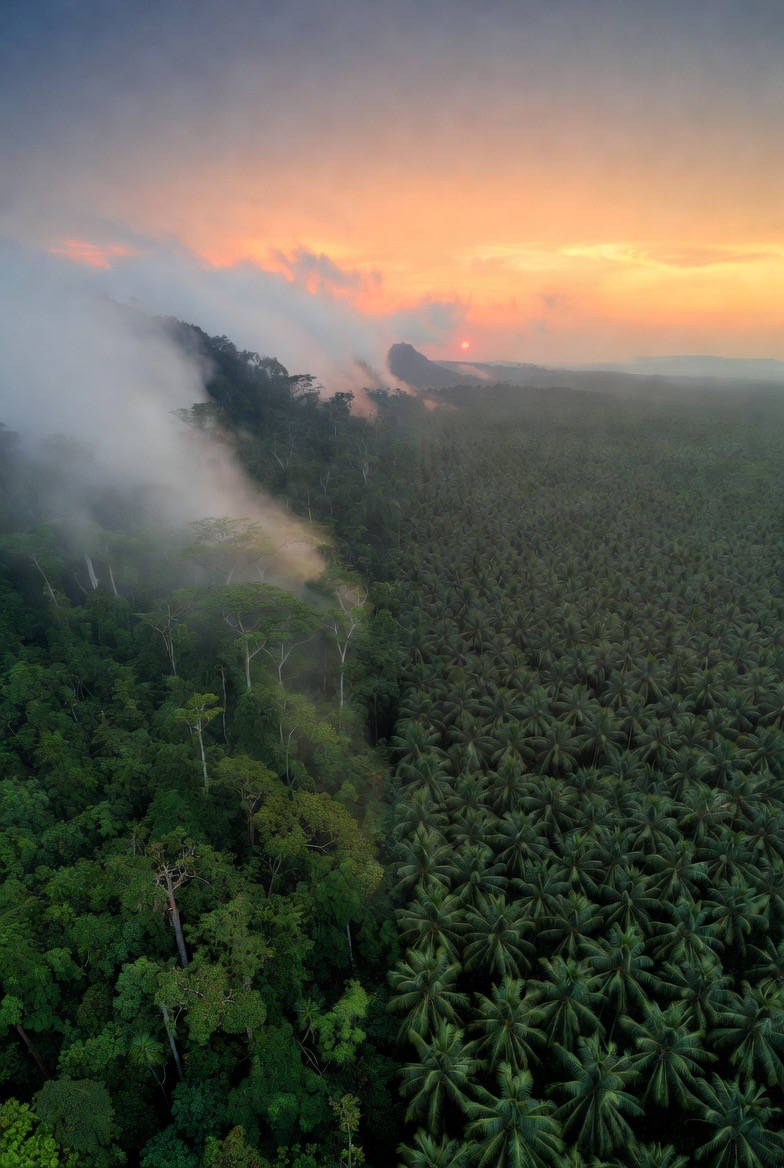
Borneo is the test case for “deforestation-free”
Borneo is one of the most biodiverse places on Earth, and it is also where a modern supply chain can be audited in near real time. The uncomfortable fact is scale: between 2000 and 2018, Borneo lost about 6.3 million hectares of forest cover, and palm oil expansion accounted for roughly 2.4 million hectares of that loss. That is not an abstract tragedy. It is habitat turned into an industrial grid, and it is the loss of a living carbon sink that stabilizes regional rainfall and global climate risk.
Palm oil drove the damage, and then rates fell
Palm oil has been the dominant industrial driver of recent forest conversion in Borneo. But the story is not frozen in 2010. Satellite backed analyses show palm driven deforestation has dropped sharply since late 2010s, including a record low in 2021. Indonesia’s industrial palm oil deforestation rose modestly in 2022, but remained far below peak years.
Why the slowdown? Part policy, part price signals, part scrutiny. Indonesia imposed a moratorium on new oil palm plantation permits (2018), and strengthened moratoria affecting primary forest and peat governance (2019). At the same time, monitoring and market pressure forced a shift toward show-your-work compliance.
Now the risk: biofuel demand can pull the system backward. Indonesia is expanding palm based biodiesel blending, tightening incentives and raising the stakes for enforcement.

Peer reviewed estimate: Over 100,000 Bornean orangutans were lost between 1999 and 2015.
The real costs: biodiversity and land rights
Bornean orangutans are the headline, but they are not the only casualty. A peer reviewed study in Current Biology estimated more than 100,000 Bornean orangutans were lost between 1999 and 2015.
Borneo’s elephants are now officially in crisis too: the IUCN reports only about 1,000 Bornean elephants remain, after roughly 60% of their forest habitat was lost in recent decades, largely from logging and plantation conversion.
And the social impact is not a footnote. Human Rights Watch documented Indigenous families in Kalimantan whose forests and farms were swallowed by plantations, including villagers left with “little land to farm and no forest in which to forage.”
Traceability and enforcement
- Mandatory due diligence for forest risk commodities, including palm oil and its derivatives, with geolocation level traceability and penalties for false paperwork. The EU has already moved in this direction through its Deforestation Regulation.
- Customs enforcement capacity, not just rules on paper. If agencies cannot audit, seize, and penalize, bad actors arbitrage the gaps.
- Indigenous land tenure and FPIC (free, prior, informed consent) as an enforceable condition, not a box to check after the fact.
- Satellite monitoring as evidence, integrated into compliance workflows (NASA imagery, Global Forest Watch methodologies, and high resolution commercial mosaics).

Leave a Reply