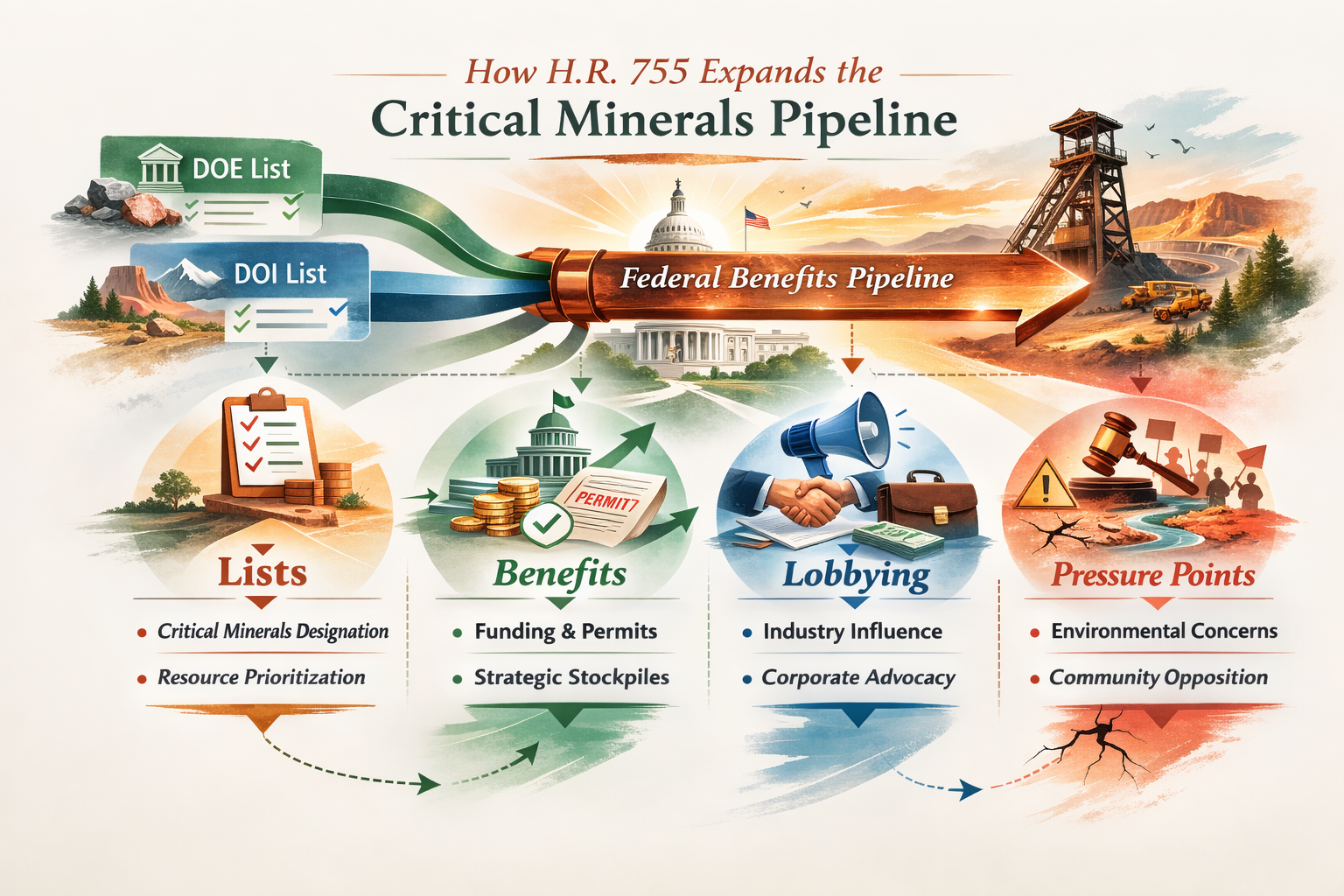
H.R. 755, the Critical Mineral Consistency Act of 2025, would require the federal government to publish a combined Critical Minerals and Materials List and use that harmonized list across relevant programs. The House passed the bill unanimously on March 3, 2026, and the Senate received it the next day, read it twice, and placed it on the calendar. The Senate also has a companion, S. 714, introduced by Mike Lee and Mark Kelly and reported by the Senate Energy and Natural Resources Committee.
Congress says this is about clarity; it is also about benefits
Supporters are selling H.R. 755 as a common-sense fix to inconsistent federal definitions. That framing is politically smart, but incomplete. Susie Lee’s office states that items on DOE’s critical materials list do not currently receive the fuller set of benefits available to DOI-listed critical minerals, including federal tax-credit and financing opportunities. Her office says the bill would extend those benefits by creating one list for federal program administration. Juan Ciscomani goes further, saying the bill would help streamline permitting, attract investment, and unlock Arizona’s mineral resources, especially copper. With that, the federal government signals its preference for economics over other concerns.
The copper fight has already changed the terrain
One reason H.R. 755 matters more now is that copper’s critical status can now be translated more directly into federal advantage. The bill forces agencies to use a single, harmonized federal list when administering programs involving critical minerals or critical materials. In practical terms, that means less ambiguity about whether a material qualifies across different parts of the government and a smoother path for federal support to line up behind it. Susie Lee’s office explicitly descibes that the mismatch between DOE and Interior lists can affect access to tax-credit and financing opportunities. Once copper is on the federal critical minerals list, H.R. 755 helps ensure that status is not trapped inside one agency’s definition but carried across the broader federal program architecture. That is why the bill matters more now: how fully will Washington convert that designation into financing, program eligibility, and coordinated agency treatment?

Washington continues to accelerate strategic extraction faster than it is building strategic accountability
The support coalition is broader than Big Mining
The bill’s public support base is bigger than many casual observers may realize. The Senate Energy and Natural Resources Committee says S. 714 is backed by the National Mining Association, Utah Mining Association, Zero Emission Transportation Association, Copper Development Association, and American Exploration & Mining Association. Susie Lee’s office adds the Transformer Manufacturing Association of America, the National Electrical Manufacturers Association, and the Business Council for Sustainable Energy. That matters. The pro-H.R. 755 coalition includes manufacturers, electrification advocates, and trade groups that see harmonized critical-mineral treatment as a supply-chain and industrial-policy win.
The Oak Flat fight: Indigenous people lose again
The lobbying record points in the same direction. BHP, Freeport-McMoRan, and Newmont all disclosed lobbying on H.R. 755 and/or S. 714. On the opposition side, Earthjustice Action disclosed lobbying on S. 714 as part of a wider mining and public-lands agenda. That asymmetry matters because one of the bill’s active lobbying beneficiaries, BHP, is also tied to one of the most politically explosive copper fights in the country. This week, after years of litigation, the federal government transferred Oak Flat to Resolution Copper, the Rio Tinto and BHP joint venture seeking to develop a major Arizona copper project opposed by Apache and environmental plaintiffs. In other words, Congress is debating a bill that widens the federal runway for critical-minerals development at the same moment one of the country’s most sacred-site conflicts is accelerating on the ground.
That helps explain why organized public opposition to H.R. 755 itself has looked muted even though the underlying conflict is real. The House passed the bill unanimously, so there is no visible anti-bill bloc on the House floor, so we must stand up for tribal-rights and ethical public-land use. Earthjustice Action, for example, lobbies the issue. Recent reporting on Oak Flat shows the San Carlos Apache and allied advocates still view the conflict as one about religious freedom, Native sovereignty, water, and irreversible land destruction. The mismatch is political as much as moral. The pro side has a clean security, manufacturing, and jobs message, while the anti side defends sacred sites and accountability in a policy environment that increasingly treats extraction speed as strategy.

The bottom line
H.R. 755 keeps moving because it is wrapped in bipartisan language about supply chains, national defense, and domestic production. But that is exactly why it deserves more scrutiny, not less. Washington continues to accelerate strategic extraction faster than it is building strategic accountability. A serious minerals policy would not just widen the fast lane for copper and other critical inputs. It would also widen the guardrails for tribes, sacred sites, cleanup liability, and traceability.


Leave a Reply