Pollution and Asthma in Children: The School Days Dirty Air Steals
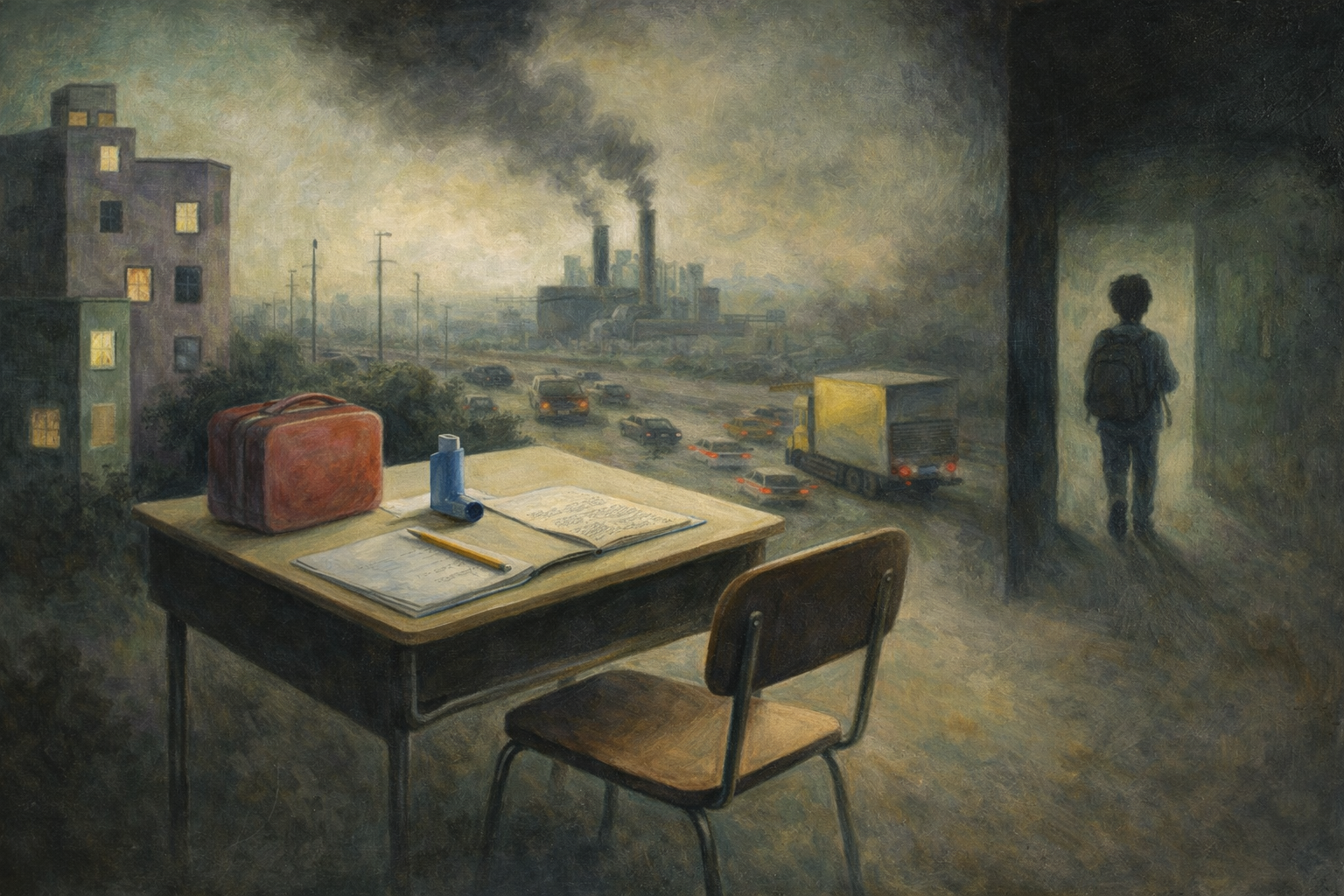
In Clairton, Pennsylvania, the story is easy to tell and hard to hear. Children living near a major coke plant were not merely breathing worse air. They were missing school because of it. Reporting published April 13, 2026, described how children with asthma near the Clairton Coke Works had an 80% higher chance of missing school when sulfur dioxide pollution was elevated. Researchers studying the area had already found unusually high asthma rates among nearby elementary-school children. The point is not that Clairton is uniquely cursed; it makes visible what much of the country prefers to keep abstract: pollution and asthma in children do not end at the doctor’s office. They show up in empty desks, disrupted lessons, worried parents, and family routines bent around the next flare.
This creates a large national burden. CDC reports that about 5.5% of U.S. children had current asthma in 2019 to 2021, and 38.7% of children with current asthma had at least one asthma attack in 2021. EPA states that asthma is a leading cause of school absenteeism and notes that students with uncontrolled asthma generally perform worse on standardized tests. Once that happens, the condition stops being a private health issue. A child with unstable asthma can miss reading instruction, quizzes, group projects, and the ordinary continuity that helps school feel manageable. A parent may miss work, scramble for transportation, or spend hours in urgent care over what gets called, too casually, an environmental issue.
Outdoor Air Still Does the First Damage
The outdoor-air case is not thin or speculative. EPA says sulfur dioxide can trigger severe asthma symptoms. Nitrogen dioxide aggravates asthma and can contribute to its development. Fine particle pollution is linked to asthma attacks, emergency visits, and hospital admissions. In other words, the pollutants most common around heavy industry, freight corridors, and busy roads are also the pollutants most capable of pushing vulnerable children out of class. Freight traffic, industrial clustering, and bad regional air all help turn childhood lungs into exposure monitors. The child coughing through first period is often living at the meeting point of policy choices about zoning, transport, compliance, and enforcement.
Home Can Quietly Make the School Problem Worse
Indoor pollution should stay secondary in this story, but it cannot be ignored. Stanford researchers reported in 2024 that gas and propane stoves can drive nitrogen dioxide to unhealthy levels not just in kitchens but in bedrooms. NO2 from gas stoves alone may account for about 50,000 current childhood asthma cases, while the broader mix of stove-related pollutants may be associated with as many as 200,000 current cases. Exposure is higher in smaller homes, which means children already under pressure from outdoor air may return home to air that does them no favors. The school problem begins outside, but it does not stay there.

Black children have 5x the hospitalization rate of white children
Stacked Exposure
An NIH-supported ECHO study published in February 2026 found that early-life PM2.5 exposure and poor indoor housing conditions such as dampness or water damage each independently raised childhood asthma risk. For many children, the real danger is stacked exposure. They breathe traffic or industrial pollution on the way to school, sit in classrooms downwind of heavy corridors, then go home to smaller, older, or moisture-damaged housing where respiratory triggers accumulate. Asthma risk compounds when bad outdoor air meets bad housing.
The Burden Falls Unequally, and Predictably
The disparity story should be explicit. CDC found that non-Hispanic Black children had the highest pediatric asthma hospitalization rates from 2012 through 2020, ranging from 9.8 to 36.7 per 10,000 children, compared with 2.2 to 9.4 for non-Hispanic White children. Another CDC analysis found current asthma prevalence among non-Hispanic Black children at 12.5%, versus 5.7% among non-Hispanic White children. EPA separately highlights the link between environmental conditions and asthma among Black children. These are not random differences in fate. They reflect where pollution is tolerated, where housing quality slips, and which families are expected to absorb the damage.
The Empty Desk Is the Real Measure
A country serious about children would not measure dirty air only in parts per billion. It would measure it in missed spelling tests, interrupted reading growth, cancelled shifts, and parents trying to decide whether the child can make it through the day. That is the real meaning of pollution and asthma in children. Dirty air does not only inflame lungs. It erodes attendance, stability, and opportunity. The empty desk is not a side effect of the pollution problem. It is one of the clearest proofs that the problem is political, cumulative, and still being tolerated.


Leave a Reply