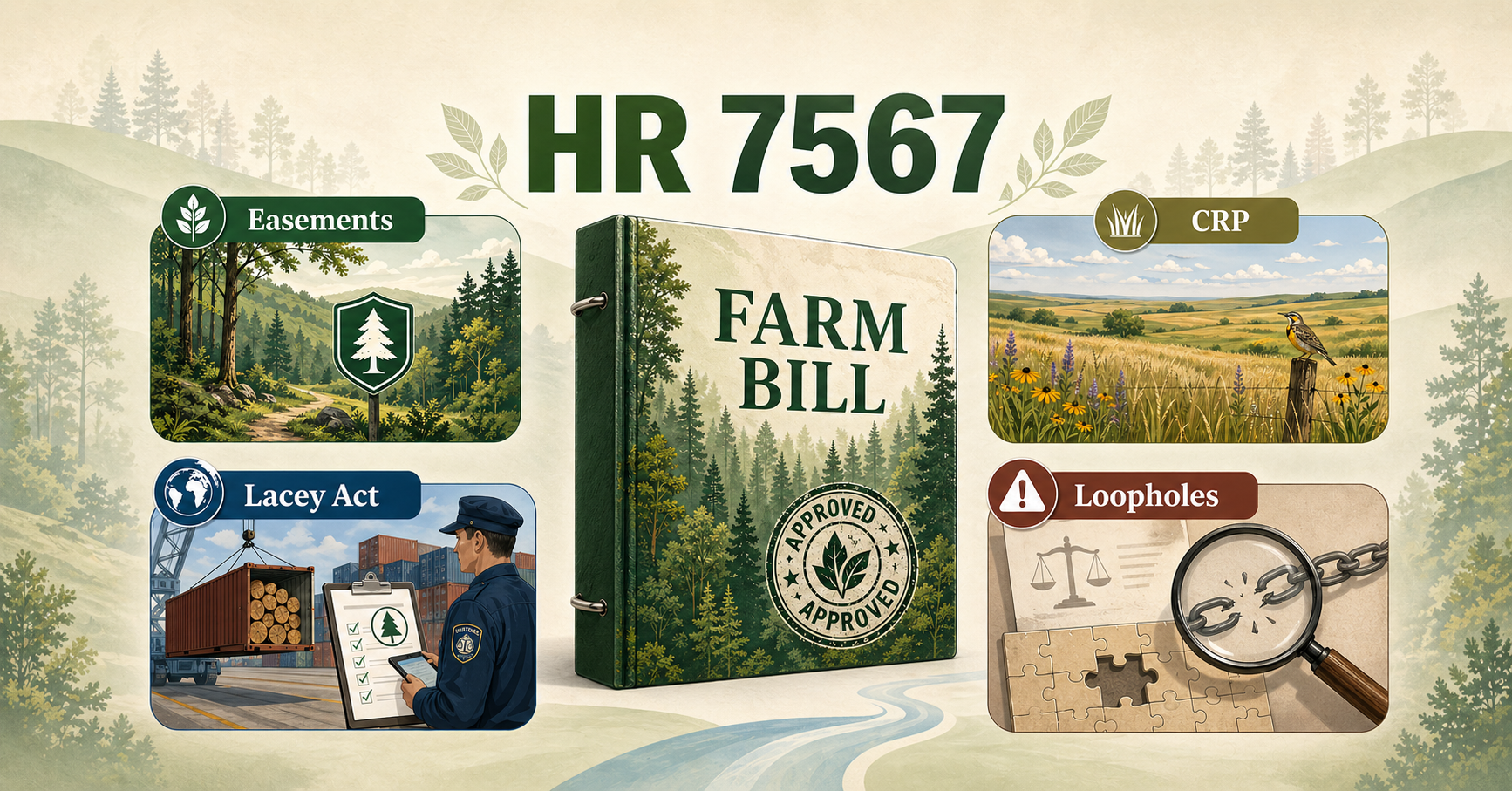
H.R. 7567 could give the country useful conservation machinery: forest easements, CRP stability, soil-health support, forestry planning, and clearer Lacey Act import procedures. It could also weaken the same public-interest architecture it claims to strengthen if Congress lets pesticide liability shields, reduced consultation duties, or looser review standards ride inside the bill. That tension makes the Farm, Food, and National Security Act of 2026 more than another Farm Bill fight. It is a test of whether Congress can fund stewardship without quietly rewarding shortcuts.
H.R. 7567, the Farm, Food, and National Security Act of 2026, belongs in any serious sustainability conversation for precisely that reason. The House Rules Committee put the bill on a possible floor track for the week of April 27, 2026, and told members to draft amendments against Rules Committee Print 119-22. CRS reports that Rep. Glenn Thompson introduced H.R. 7567 on February 13, 2026, and that the House Agriculture Committee ordered it reported favorably, as amended, on March 5 by a 34-17 vote.
The conservation case for the bill rests on easements, CRP, soil-health capacity, forestry planning, and import transparency. The case against the bill rests on review carveouts, pesticide accountability, and the risk that procedural speed becomes a substitute for stewardship.

$227 million for the Forest Conservation Easement Program
The Conservation Title Contains Real Tools
Title II gives sustainability-minded readers a real reason to take H.R. 7567 seriously. CBO says the bill would authorize or amend USDA programs for agricultural land conservation, food aid and agricultural trade promotion, rural development, agricultural research, forestry, nutrition, horticulture, and other areas through 2031. CRS also identifies conservation as one of the bill’s central policy areas and notes that H.R. 7567 would reauthorize the Conservation Reserve Program at 27 million acres through FY2031.
Conservation programs shape private land before crisis politics reaches the scene. Congress can talk about biodiversity, soil health, and watershed protection all it wants. USDA programs decide whether landowners can afford to keep conservation practices on the ground.
H.R. 7567 would create a Forest Conservation Easement Program. The bill directs USDA to establish the program for conservation and restoration of eligible land and natural resources through conservation easements or other land interests. It also names working forest viability, forest ecosystem and landscape functions, and habitat for threatened, endangered, and at-risk species as program purposes. CBO estimates that the forest easement subtitle would increase direct spending by $227 million over FY2026-FY2036.
That language creates statutory capacity, not merely rhetorical cover.
Easements Need Management, Not Romance
Forest easements deserve support, but they do not deserve romance. Easements can keep forest land from conversion, which protects carbon, biodiversity, water, and habitat. They do not automatically create active management.
A forest easement can block subdivision and nonforest conversion. It cannot, by itself, guarantee invasive-species control, wildfire-risk reduction, habitat monitoring, road discipline, or durable stewardship funding. Congress should fund protection, then fund the boring machinery that makes protection operational.
The same logic applies to CRP. The program does more than pay farmers to idle marginal land. It turns private acres into ecological infrastructure: grassland habitat, water-quality buffers, flood moderation, carbon storage, and wildlife corridors. H.R. 7567 deserves a land-systems reading, not just a farm-subsidy reading.
The Lacey Act Language Tests Traceability
The bill’s most important trade provision looks procedural. Section 12405 requires USDA, working with U.S. Fish and Wildlife Service and Customs and Border Protection, to issue guidance so importers of plants denied entry or detained under the Lacey Act can obtain more information. The bill calls for information on the reasons for detention, the likely detention timeline, the nature of tests or inquiries, and the information that could speed disposition.
That provision could improve enforcement discipline, or it could weaken it. If agencies use the guidance to clarify expectations, reduce importer confusion, and strengthen documentation standards, the provision can help. If importers use the guidance to pressure agencies into premature release, the provision can erode the enforcement leverage that makes the Lacey Act matter.
The standard should stay simple. Transparency for importers must preserve detention authority, strengthen species and origin verification, and give enforcement agencies enough resources to test legality claims. Import restrictions only work when traceability, customs enforcement, chain of custody, and penalties function together.

Forestry Reform Needs Guardrails
Title VIII requires the closest read. H.R. 7567 contains serious forestry provisions: state forest strategies, restoration partnerships, hazardous-fuels work, water-source protection, forest inventory, reforestation, wood innovation, biochar, and white oak resilience. Some provisions improve the “show your work” side of forest policy.
Policy geeks should care about these details because forest statutes often hide the fight in process words: consultation, categorical exclusion, maintenance, restoration, and emergency. H.R. 7567 addresses forest management activity, roads, temporary-road decommissioning, wildfire suppression, and Good Neighbor Authority.
The risk appears in the same title. H.R. 7567 says certain designated forest management activities may not include new permanent roads. It allows maintenance and repair of existing permanent roads, and it requires temporary-road decommissioning within three years. That structure permits a nuanced position. Road discipline matters. Congress should not turn restoration authority into future fragmentation infrastructure.
The bill also says certain forest management activity will not face Section 7 Endangered Species Act consultation or Section 106 National Historic Preservation Act review. That provision deserves a hard stop. A sustainability bill cannot call itself serious while removing consultation duties where listed species, habitat, or historic resources may face material risk.
Pesticide Riders Threaten the Bill’s Conservation Credibility
H.R. 7567 also carries a pesticide-accountability fight. The Guardian reported that public-health and environmental advocates argue the bill would delay safety reviews, increase industry influence, and shield pesticide manufacturers from some state-level failure-to-warn claims. The Rules Committee amendment list also shows members trying to remove or replace language that limits state authority over pesticide regulation.
The post does not need to become a pesticide-law treatise. But it should name the problem. Conservation money cannot launder accountability rollbacks. If Congress funds soil health with one hand and weakens health, biodiversity, or liability tools with the other, the bill fails the market-integrity test.
Amend the Bill, Do Not Greenwash It
A serious sustainability position on H.R. 7567 should be conditional. Keep the Forest Conservation Easement Program. Protect CRP stability. Fund state and Tribal soil-health capacity. Strengthen Lacey Act traceability. Preserve rigorous review where forestry projects affect habitat, water, roads, and public participation. Strip or tighten provisions that weaken pesticide accountability, ESA consultation, or meaningful enforcement.
That approach works better than reflexive praise or reflexive opposition. H.R. 7567 touches trade, land management, appropriations, enforcement, and private-land incentives at the same time. Congress rarely gets a clean conservation vehicle. It usually gets a sprawling bill with useful machinery, hidden concessions, and fights buried in clauses.
Every sustainability bill should face the same test: does it verify, enforce, and protect? H.R. 7567 contains real conservation architecture, but Congress must not let that architecture shelter shortcuts. Forest policy does not fail only when trees fall. It also fails when the paperwork says “conservation,” while the market rewards the opposite.


Leave a Reply