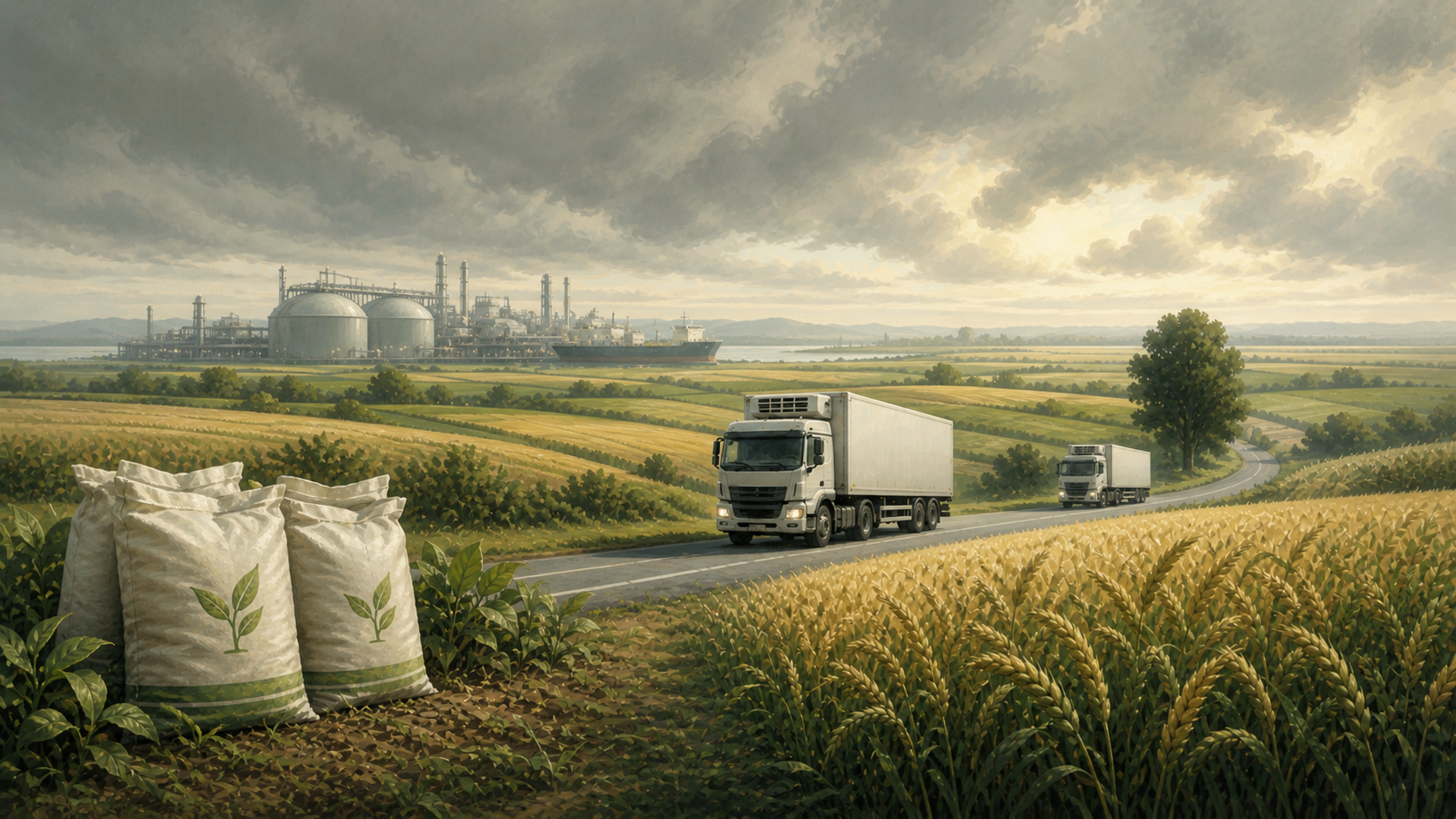
The Hormuz crisis no longer needs explanation as a supply-chain event. The numbers do it: the World Bank projects energy prices up 24% and fertilizer prices up 31% in 2026. The pressure now runs straight through LNG, food systems, freight, factories, and sustainability standards.
How the Hormuz LNG Crisis Raises Costs Across the Economy
Oil gets the public attention because gasoline prices feel immediate. LNG works less visibly but reaches deeper into the economy. The U.S. Energy Information Administration says the Strait closure has affected more than 10 billion cubic feet per day of LNG supply, about 20% of the global total, mostly tied to Qatar’s Ras Laffan export facility.
Since LNG helps power grids, heat industrial processes, produce fertilizer, support cold chains, and move goods, the issue for sustainability-minded people is what happens to standards when energy, food, freight, and factory costs rise at the same time.
How Inflation Pressure Weakens Sustainability Standards
The sustainability problem starts when price pressure changes behavior. A government trying to hold down costs may delay enforcement. A manufacturer may move to a cheaper supplier with less scrutiny. A retailer may prize availability over verification. A household may choose the lower sticker price because food, rent, utilities, and transportation already stretched the budget.
Petrochemicals make this concrete. Reuters reports that $20 billion to $25 billion in petrochemical products pass through the Strait each year. Disruptions have lifted prices for plastics and polymers, which appear in products ranging from auto parts to toys, to roughly four-year highs. Polyethylene prices on China’s Dalian Commodity Exchange rose nearly 37%, while polypropylene prices rose more than 38% after the conflict began.
As a result, plastics, packaging, shipping materials, construction inputs, medical supplies, and household goods all increase in cost. When costs rise quickly, weak sustainability programs bend first. Companies with shallow supplier visibility can change sources quickly and ask fewer questions. Governments can frame due diligence as delay. Consumers can treat verified products as luxuries.

When costs rise quickly, weak sustainability programs bend first.
Why Resilient Supply Chains Handle Energy Shocks Better
The countries and companies best positioned for this crisis will likely share one trait: they built resilience before the shock. They will have more diverse energy sources, better storage, stronger supplier visibility, more efficient logistics, and less dependence on one exposed route or one fragile input.
The EIA gives one useful example from the United States. U.S. LNG terminals already run at high utilization, with exports at an estimated 17.9 Bcf/d in March, the second-highest monthly volume after December 2025’s 18.4 Bcf/d record. That limits how much extra U.S. LNG can replace missing global supply in the short run.
So resilience does not mean one country or supplier can instantly fill every gap. It means a system has options before panic arrives. Energy efficiency, diversified sourcing, transparent procurement, and reliable logistics carry practical value because they reduce exposure to sudden scarcity.
What the Crisis Reveals About Sustainability Under Pressure
The clearest lesson is sober: price shocks make sustainability more important and harder to maintain at the same time. The long-term case grows stronger because volatile fuel routes and concentrated supply chains create economic risk. The short-term politics grow harder because households, companies, and governments want relief now.
Humanitarian logistics show the pressure in its harshest form. Reuters reports that the cost of moving 2,018 metric tons of relief items from Dubai to Sudan and neighboring Chad more than doubled, rising from $927,000 to $1.87 million, after the Iran crisis disrupted shipping and raised fuel and insurance costs. UNHCR also said war-risk insurance premiums for Gulf transits reached an estimated 0.5% to 1.5% of cargo value.
Ordinary households experience the same structure less visibly. Costs move through energy, fertilizer, food, freight, packaging, manufacturing, and credit. The final price may look like a grocery problem, a utility problem, or a school-supply problem, but the pressure often began far upstream.
That is why the Hormuz crisis offers such a serious test for sustainability standards. Calm periods can hide weak assumptions. Cheap energy can hide inefficient logistics. Stable shipping lanes can hide risky sourcing. Low inflation can hide the cost of weak verification.
Crisis removes those cushions.
A brittle economy treats sustainability as an upgrade for good times. A more resilient economy builds it into the systems that keep goods moving, prices steadier, and standards intact when shortcuts become tempting.


Leave a Reply