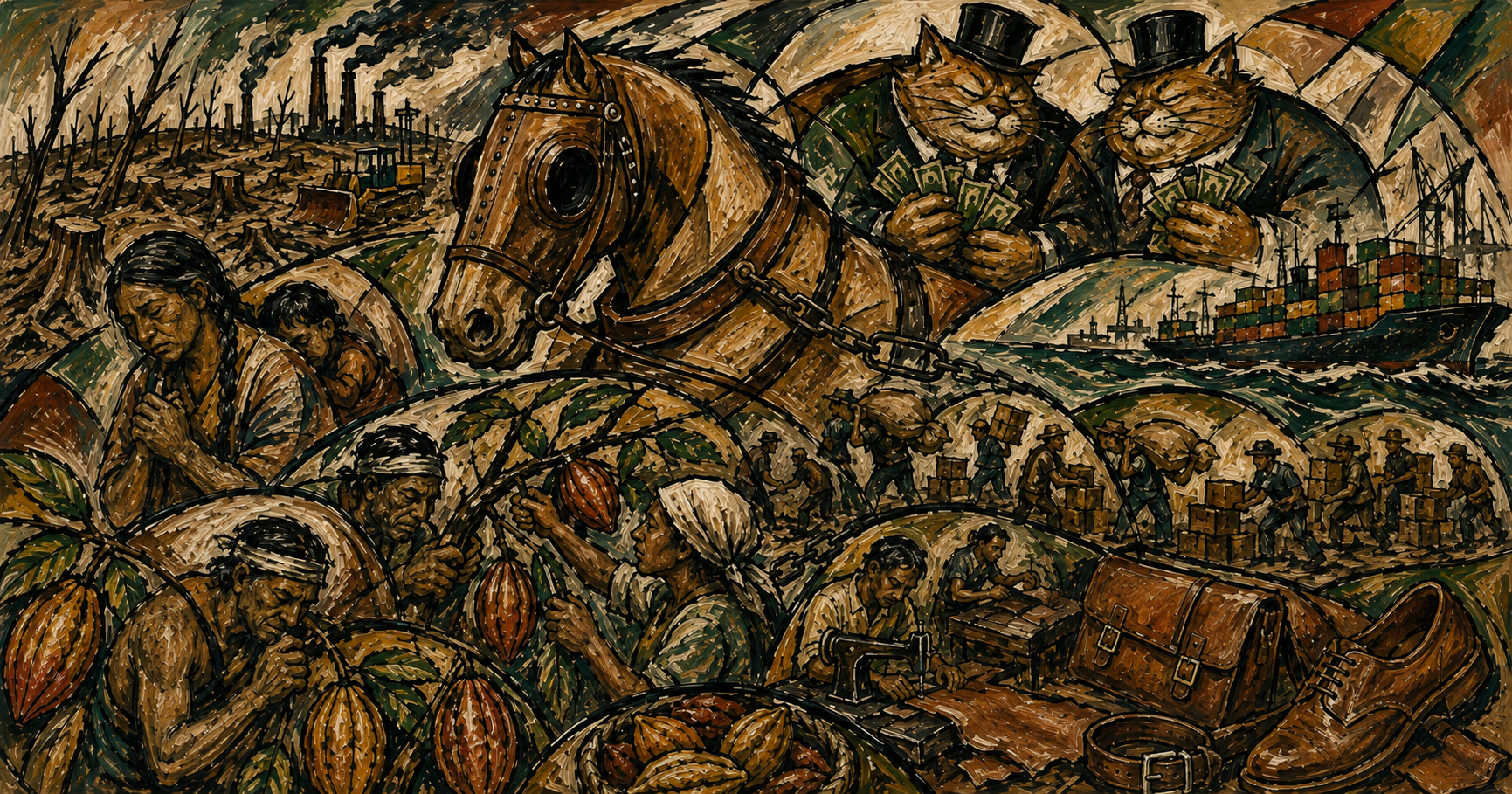
There is a kind of legislation that enters Congress wearing a clean collar. It speaks of sovereignty. It speaks of jobs. It speaks of American independence from foreign bureaucrats. Then one reads the machinery inside it and finds the old trick: protect the powerful from being asked where the money came from, where the timber came from, where the minerals came from, and whose land or labor paid the hidden price.
H.R. 4279 did not die after its 2025 introduction. It waits in committee, where ugly little favors learn to walk before the public sees a floor vote. Rep. Scott Fitzgerald introduced the PROTECT USA Act on July 2, 2025; Congress.gov still lists it at the Introduced stage, with the latest House action sending it to Energy and Commerce and Judiciary. Sen. Bill Hagerty’s companion bill, S. 985, sits in Senate Foreign Relations. The bill targets the paperwork that makes supply-chain due diligence real: assessment, corrective action, and reporting on environmental and social harm.
H.R. 4279 Does Not Merely Oppose Europe
Supporters will say American companies should not answer to Brussels. That argument has force. It also serves as the curtain.
Behind it sits a broader proposition: Congress should shield companies not only from foreign penalties, but from supply-chain disclosure itself. H.R. 4279 defines “foreign sustainability due diligence regulation” as any foreign rule that requires a person to assess environmental or social impacts, act on those impacts, and report the impacts and actions. It specifically includes the European Union’s Corporate Sustainability Due Diligence Directive. Then it tells covered American entities not to comply, except for limited ordinary-business or U.S.-law exceptions.
Translated from congressional language into market language, the bill says this: do not ask too many questions. Do not follow the paperwork too far. Do not make American firms prove what they would rather merely claim.
That deserves more than a procedural shrug. Forest protection becomes real at the market gate, where law decides whether goods tied to forest destruction, forced labor, or land abuse receive the same access as verified goods.

A market that punishes evidence is not free. It is merely well-dressed corruption.
Supply-Chain Due Diligence Is Evidence
A clean supplier has receipts. A dirty supplier has excuses.
That is the moral economy of supply-chain due diligence. It does not save a forest by producing a report. It saves a forest by making the report hard to fake, the shipment hard to launder, and the buyer unable to say, “We did not know.”
The bad actor loves a market without memory. Timber becomes “wood products.” Palm oil becomes an ingredient. Cocoa becomes a line item. A mineral pulled through coercion becomes a battery input. By the time the product reaches the shelf, the forest has vanished, the worker has disappeared, and the consumer sees only price.
Due diligence interrupts that laundering. It asks origin, labor conditions, land-use history, and whether a certificate covers the actual product or merely decorates a sales pitch. It turns ethics from a slogan into a file that investigators, buyers, and citizens can check.
That is why H.R. 4279 cuts so deep. It attacks the paperwork infrastructure that lets responsible producers compete against firms that hide risk in the dark.
The National Interest Should Not Mean National Blindness
The bill reaches the sectors where verification matters most: agriculture, mining, timber, manufacturing, fossil fuels, arms production, and critical minerals. It even sweeps in federally listed critical minerals and fuel minerals.
That scope gives away the stakes. This is not an abstract fight over European paperwork. It reaches the arteries of the modern economy: food, forests, energy, minerals, defense, manufacturing, and the so-called clean transition.
A country can secure its supply chains by building traceability, enforcing labor standards, and rewarding clean suppliers. Or it can call every demand for documentation an attack on sovereignty.
That false choice deserves rejection.
Security without traceability is dependency with a flag on it. A supply chain that cannot answer basic questions about origin, labor, land, and enforcement is not secure. It is brittle. It is corruptible. It waits for the next scandal, shortage, lawsuit, or diplomatic crisis.

The Real H.R. 4279 Test
The bill’s enforcement structure completes the trap. It blocks recognition of certain foreign judgments tied to sustainability due-diligence rules, authorizes presidential action to protect covered entities, creates a private right of action, and allows civil penalties up to $1 million.
That flips accountability upside down. The question should be: did the company take reasonable steps to avoid forest destruction, forced labor, illegal clearing, and supply-chain fraud?
H.R. 4279 asks a different question: did someone pressure a covered company to participate in a foreign due-diligence system?
That is not market freedom. It is a shield for opacity.
H.R. 4279 should be opposed unless Congress rewrites it beyond recognition. A defensible bill could protect American legal sovereignty while preserving voluntary compliance, responsible sourcing systems, documentation, and participation in due-diligence regimes that help companies prove lawful and ethical sourcing.
The present bill treats sustainability due diligence as the threat. The real threat is the hidden market: illegal clearing, forged paperwork, coerced labor, weak enforcement, and commodities whose sellers push the real cost onto forests, workers, Indigenous communities, and honest competitors.
American firms should not answer to foreign governments. But they should answer basic questions about whether their profits depend on forest destruction, labor abuse, or supply-chain fraud.
A market that punishes evidence is not free. It is merely well-dressed corruption.

Leave a Reply