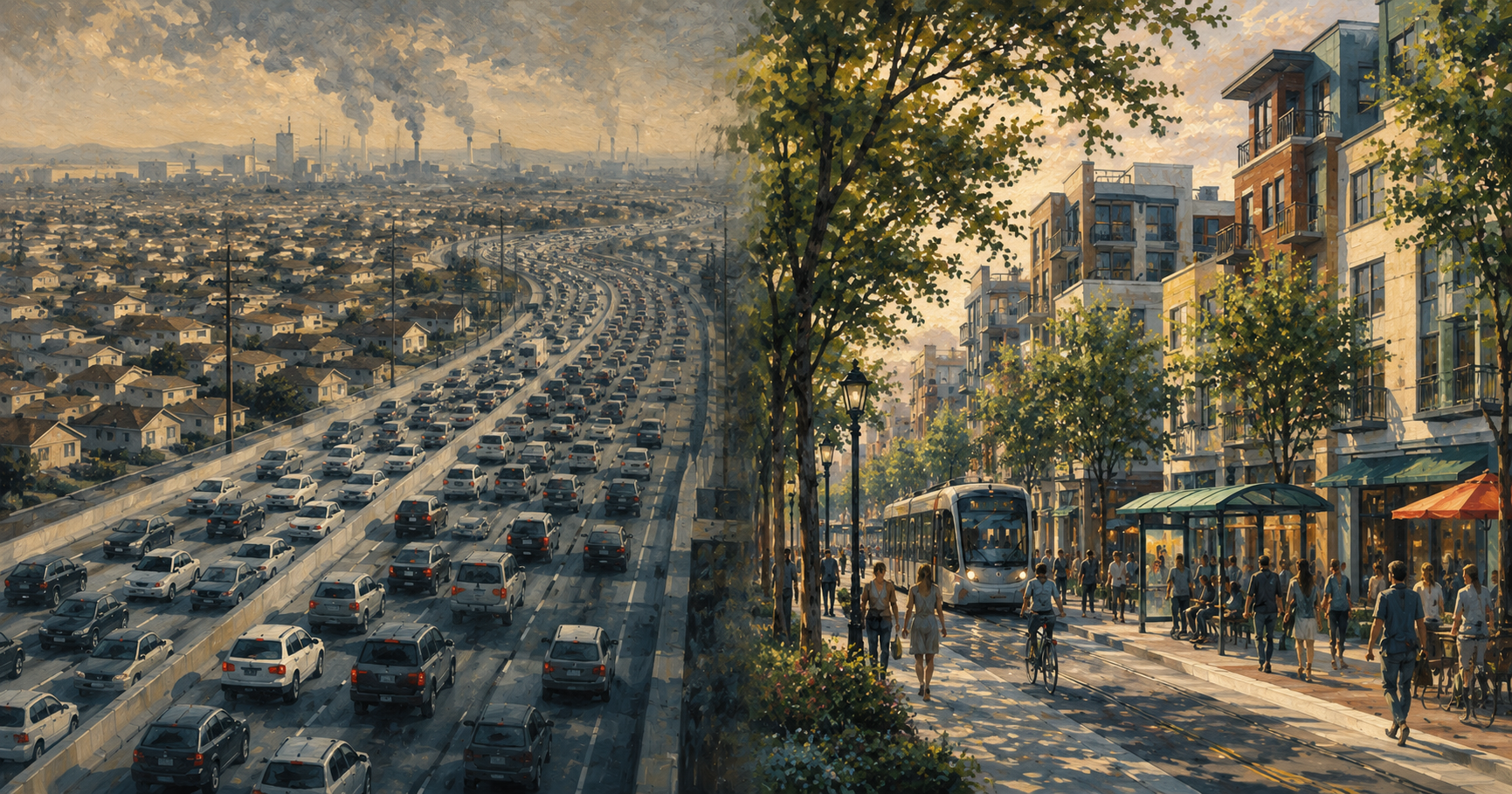
America’s affordability crisis extends beyond housing prices. Inefficient buildings and car-dependent development raise utility bills, transportation costs, and infrastructure burdens that quietly drain middle-class households every month.
America does not just face a housing affordability crisis. It faces a design efficiency crisis.
Millions of households now live inside systems that require excessive spending simply to maintain ordinary life. Families pay more for transportation, utilities, insurance, and infrastructure because many American communities still rely on inefficient buildings and car-heavy development patterns that amplify recurring costs year after year.
Inflation grows when physical systems force households to consume more fuel, more energy, and more infrastructure than necessary.
The encouraging news is that some of the most effective sustainability solutions also lower long-term household expenses.
Efficient Buildings Act Like Permanent Tax Cuts
Most Americans think of inflation as something external. They picture gas prices, grocery stores, or tariffs. Yet many households quietly lose hundreds or thousands of dollars annually because their homes waste energy every day.
The U.S. Department of Energy estimates that efficiency upgrades such as insulation improvements, HVAC optimization, and LED lighting can reduce household energy bills by roughly 20–30%, often saving families hundreds or even thousands of dollars annually depending on region and housing stock.
That reduction would help middle-class households already stretched by rising insurance costs, elevated rents, childcare expenses, and transportation burdens.
An efficient home lowers recurring monthly costs without demanding major lifestyle sacrifice. Better insulation stabilizes indoor temperatures. Modern HVAC systems consume less electricity during extreme weather. Efficient windows reduce heating and cooling loss while improving resilience during heat waves and cold snaps.
These changes sound technical, but their effects are significant.
A household saving $1,000 annually on utilities effectively receives a recurring raise without working additional hours or taking on additional risk.
That is why building efficiency deserves far more attention as economic policy rather than niche environmental policy.

Transportation Costs Quietly Drain Household Wealth
Transportation creates a similar pressure point.
Research from the Urban Land Institute and the EPA shows that compact, transit-oriented development can save households thousands of dollars annually by reducing vehicle dependence and commute burdens.
Many Americans understandably focus on mortgage or rent payments when choosing where to live. But transportation often becomes the second major monthly expense after housing itself. That expense compounds rapidly when households require multiple vehicles, long commutes, elevated fuel consumption, and expensive insurance coverage simply to participate in daily life.
Car dependency also magnifies exposure to inflationary shocks. Fuel spikes, auto-loan interest rates, insurance repricing, and repair inflation all hit harder when driving remains structurally unavoidable.
A shorter commute or walkable neighborhood therefore does more than improve convenience. It can materially reduce long-term financial pressure while giving households greater flexibility during economic downturns.
Good Urban Design Reduces Economic Fragility
The strongest sustainability policies often succeed because they reduce fragility.
A resilient neighborhood usually combines nearby services, accessible transit, shorter infrastructure networks, and energy-efficient housing in ways that lower both household and municipal costs over time.
For example, compact infrastructure generally costs less to maintain per resident than sprawling infrastructure stretched across enormous suburban footprints. Cities and counties then face lower long-term obligations tied to roads, utility lines, emergency response coverage, and water systems.
Those savings eventually matter to taxpayers because deferred infrastructure costs rarely disappear permanently. They typically reappear through taxes, utility increases, insurance premiums, or declining public services.
Well-designed communities therefore create a compounding effect. Households save money directly. Municipalities reduce maintenance strain. Infrastructure lasts longer. Energy demand becomes more manageable. Transportation volatility affects fewer families.
That combination strengthens economic resilience far beyond environmental branding.
Sustainability Works Best When It Improves Daily Life
Many Americans remain skeptical of sustainability messaging because they associate it with sacrifice, moralizing, or expensive lifestyle signaling.
Some skepticism is understandable. Policies that raise costs without improving reliability or affordability rarely maintain durable public support.
But efficient systems create a different argument altogether.
A well-insulated apartment near work often produces lower utility bills, lower fuel costs, reduced maintenance expenses, and less exposure to inflation shocks. Those outcomes benefit households regardless of political ideology.
This is where sustainability politics may evolve over the next decade. The strongest arguments increasingly center on resilience, stability, efficiency, and lower recurring expenses rather than symbolic consumption choices.
Young and middle-class college graduates increasingly care about whether systems function well under pressure. Many entered adulthood facing inflated housing costs, student debt, stagnant purchasing power, volatile insurance markets, and expensive transportation systems.
They do not necessarily want abstract lectures about sustainability. They want systems that lower recurring costs and improve long-term stability.
America Needs an Affordability Infrastructure Strategy
America’s affordability crisis will not disappear through interest-rate policy alone.
The country also needs an infrastructure strategy that treats efficient living as an economic advantage rather than a cultural preference.
That means:
- building housing closer to jobs and services
- modernizing inefficient housing stock
- supporting walkable mixed-use development
- strengthening grid resilience while reducing unnecessary energy waste
None of these solutions eliminate inflation entirely. But they reduce the number of ways ordinary households bleed money every month.
That matters because recurring expenses shape economic security more powerfully than one-time political talking points.
America’s hidden inflation engine is not only monetary.
It is structural inefficiency embedded directly into the places people live.



Leave a Reply