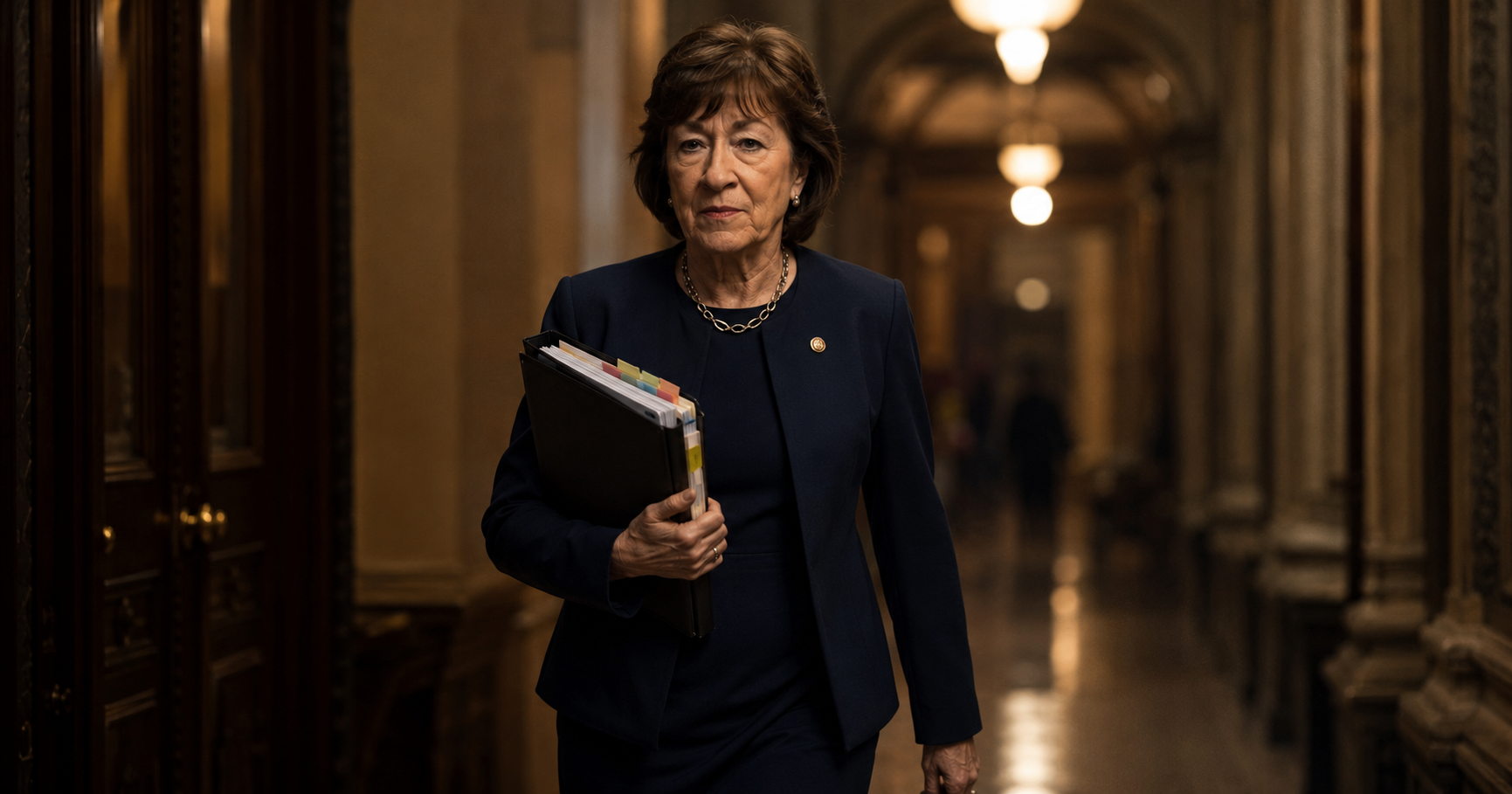
Many Republicans still speak the language of conservation, resilience, energy independence, or climate adaptation. Very few still possess the institutional authority to shape environmental governance from inside the Republican coalition itself, especially at the level where agencies, land-management systems, and enforcement structures either receive operational support or slowly lose capacity over time.
That reality helps explain why the 2026 Maine Senate race carries importance far beyond one state or one senator.
Most national coverage will frame the contest around Senate control, polarization, or the personal political survival of Senator Susan Collins. Those dynamics matter, but they do not fully capture the larger institutional issue now emerging beneath the campaign. The more consequential question involves whether the Republican Party still rewards lawmakers who preserve portions of the federal environmental governing framework rather than treating environmental administration itself as politically suspect.
Environmental governance in Washington rarely turns on speeches alone. Congress shapes sustainability policy through appropriations negotiations, staffing levels, wildfire funding, fisheries oversight, tribal environmental programs, conservation enforcement, watershed restoration, and the slow bureaucratic mechanics that determine whether federal agencies retain the operational ability to function at scale. Collins occupies one of the most influential positions inside that system as chair of the Senate Appropriations Committee, where she helps determine the funding architecture behind the EPA, Interior Department, Forest Service, National Park Service, and major federal land-management programs.

Collins has been an outlier for Republicans
When Collins helped move the FY2026 Interior and Environment appropriations package above House spending levels, she demonstrated how committee power still shapes environmental governance more decisively than campaign rhetoric does. The package preserved substantial funding streams for wildfire management, environmental enforcement, federal land operations, tribal programs, watershed protection, and conservation administration during a period when many Republicans openly advocated significant reductions in federal environmental capacity.
The statistical profile of Collins’ environmental record further clarifies why sustainability advocates continue watching her race so closely. The League of Conservation Voters has given Collins lifetime environmental scores in the low-to-mid 60s across her Senate career, dramatically above most contemporary Republicans and often closer to moderate Democrats than to the modern GOP median. During several Congresses in the Trump era, Collins recorded annual environmental voting scores above 70%, while many Republican senators remained below 20%.
Her record also includes support for bipartisan infrastructure investments tied to grid modernization and resilience, backing for major fisheries protections central to Maine’s coastal economy, and repeated defense of funding streams for environmental agencies during appropriations negotiations. She has not aligned herself with the activist left of climate politics, yet she has consistently operated from a governing tradition that treats forestry, fisheries, watershed management, and environmental stability as practical components of economic stewardship rather than purely ideological categories.
Maine’s economy reinforces that governing instinct. Lobster fisheries, timber interests, tourism, coastal infrastructure, and winter heating costs all create pressure for elected officials who can balance industrial concerns with ecological durability over long time horizons.
For sustainability advocates, the most revealing question surrounding Collins does not involve whether she votes like a progressive Democrat. She plainly does not. The more important issue concerns whether Senate Republicans still value members who preserve institutional environmental capacity instead of rewarding only those who frame federal environmental agencies as adversarial actors.
The Disappearance of the Managerial Republican
American environmental governance once depended heavily on a Republican archetype that has nearly disappeared from national politics: the managerial institutionalist.
These lawmakers rarely identified as environmental activists, and many strongly favored business growth, industrial expansion, and restrained regulation. At the same time, they generally accepted that forests required management, fisheries required enforcement, water systems required oversight, and pollution created measurable economic and public-health costs that markets alone could not always absorb effectively.
That governing tradition helped sustain major bipartisan environmental frameworks throughout the twentieth century because both parties retained at least partial ownership of the institutions involved. Republicans and Democrats often disagreed over regulatory scope, but many still shared an interest in preserving the operational capacity of the agencies themselves.
Today, much of that governing class has either retired, lost primaries, or adapted to a Republican coalition increasingly skeptical of federal environmental administration as a category of governance.
Collins remains one of the few nationally significant figures still operating within that older institutional framework while holding meaningful committee power.

Can long-term environmental governance survive as a purely progressive project?
Why This Race Matters for Sustainability Politics
The Maine Senate race intersects directly with several core sustainability concerns that extend far beyond climate branding or partisan messaging.
1. Conservation Enforcement Capacity
Environmental statutes carry limited value without agencies capable of implementing them effectively over time.
Illegal clearing, understaffed land-management offices, weak permitting enforcement, and hollowed-out field operations create governance vacuums that allow destructive extraction systems to flourish. Federal appropriators play a central role in determining whether sustainability standards function as operational realities or remain aspirational language inside policy documents.
2. Wildfire and Resilience Funding
Federal land management now sits near the center of American climate adaptation policy. Wildfire mitigation, prescribed-burn programs, watershed restoration, flood resilience projects, and forest-management operations all depend heavily on appropriated federal dollars that must survive annual budget negotiations.
The administrative side of resilience policy matters every bit as much as the rhetorical side.
3. Stable Corporate Planning
Large corporations often prefer regulatory continuity over abrupt ideological swings because long-term investments in energy, forestry, infrastructure, shipping, insurance, and manufacturing require stable planning assumptions. When elections repeatedly threaten to reverse enforcement structures, permitting priorities, and funding commitments before projects mature, both public agencies and private-sector actors struggle to plan effectively across decades.
For many years, moderate Republican appropriators helped soften some of those transitions by preserving at least partial continuity in environmental governance across changes in party control.
That stabilizing function has become increasingly rare inside modern congressional politics.
If Collins Loses, Who Replaces Her?
If Collins loses reelection while Republicans retain Senate control, another senior Republican appropriator would likely assume a leadership role with enormous influence over environmental funding and federal administrative capacity.
Several possible successors illustrate how sharply Senate environmental governance could evolve over the next decade.
Senator Mitch McConnell
Mitch McConnell remains one of the Senate’s most experienced institutional operators and already serves on Appropriations.
McConnell’s governing priorities historically center on judicial power, industrial economics, defense posture, and party durability rather than conservation governance itself. He can negotiate transactional agreements when necessary, but his political identity has never revolved around preserving environmental administrative structures as a governing objective. Under a McConnell-led appropriations structure, Republicans would likely continue supporting strategic infrastructure and industrial investment while placing less emphasis on environmental enforcement continuity or agency preservation.
Senator John Kennedy
John Kennedy would represent a more openly populist and confrontational direction.
Kennedy combines sharp media instincts with a coalition strongly aligned toward fossil-fuel production, deregulation, and skepticism toward federal environmental bureaucracy. Environmental funding negotiations under Kennedy would likely become more ideological, more combative, and less managerial in tone.
Senator Lisa Murkowski
Lisa Murkowski represents the closest philosophical analogue to Collins inside the current Republican conference.
Alaska forces an unusually complex balancing act between extraction economics and ecological stewardship because fisheries, tribal governance, Arctic infrastructure, public lands, and energy development all intersect inside the same political environment. Murkowski therefore approaches conservation through institutional management and resource durability rather than ideological branding. For sustainability advocates searching for surviving examples of center-right environmental governance, she may represent the strongest remaining model after Collins.
Senator Shelley Moore Capito
Shelley Moore Capito already chairs the Senate Environment and Public Works Committee and possesses substantial infrastructure and appropriations experience.
Capito generally frames environmental policy through industrial transition, energy reliability, and permitting efficiency rather than conservation-first politics. Her leadership would likely produce a more industry-accommodating environmental framework focused on infrastructure deployment and economic transition management.
The Larger Strategic Question
The Collins race ultimately raises a larger question about the future structure of American sustainability politics.
Can long-term environmental governance survive as a purely progressive project, or does durable sustainability require at least some institutional buy-in from center-right governing factions as well?
Environmental systems operate across decades while political coalitions shift rapidly. When sustainability policy depends entirely on one coalition, each election creates pressure to reverse enforcement structures, funding commitments, permitting priorities, and infrastructure planning before projects fully mature. Agencies lose continuity, industries hesitate, and states adapt unevenly to shifting federal expectations.
Older forms of moderate Republican institutionalism once reduced some of that instability by preserving partial continuity across administrations even amid broader ideological disagreement.
Susan Collins may represent one of the last nationally influential senators still operating inside that tradition while holding meaningful appropriations power.


Leave a Reply