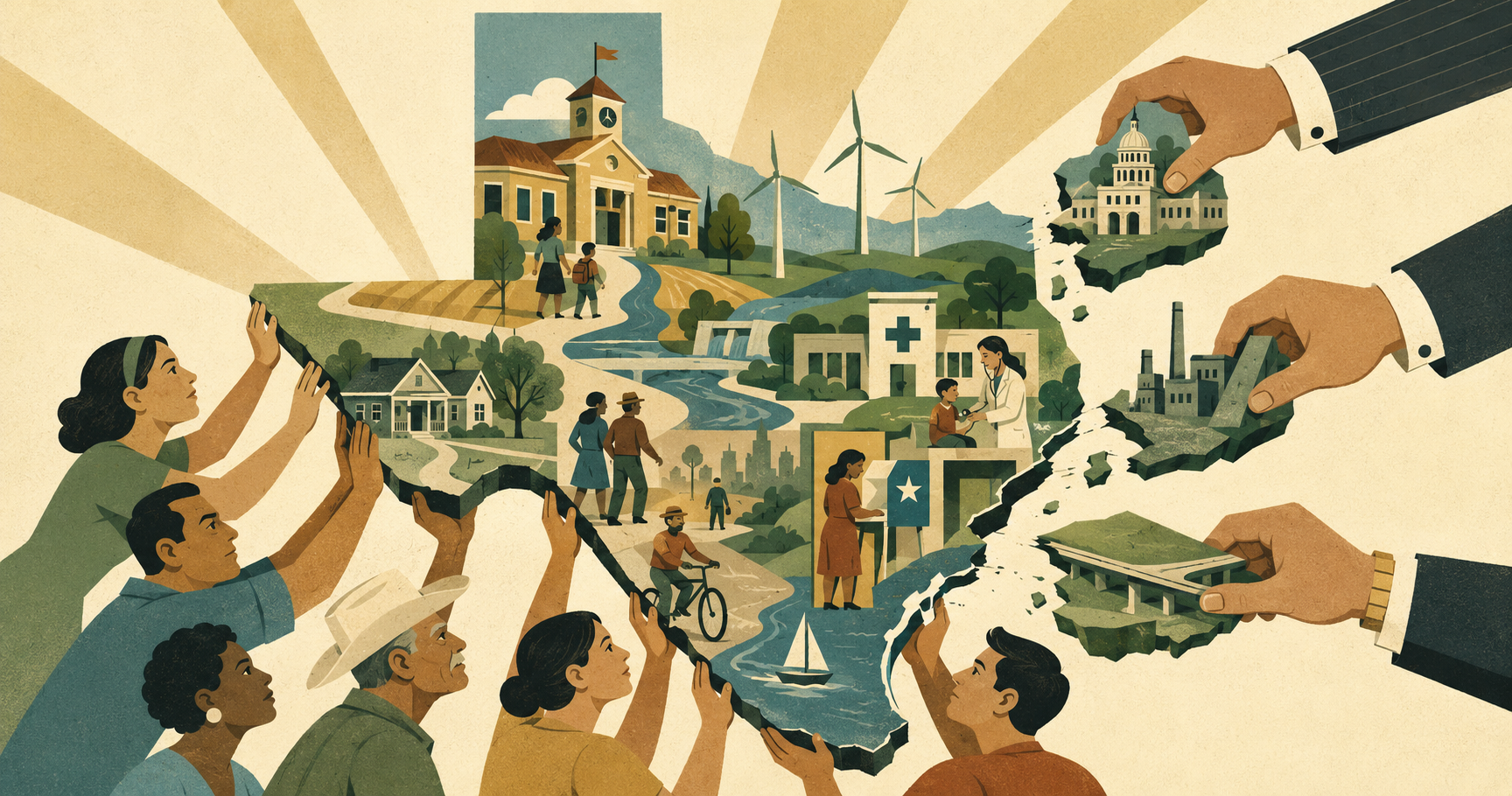
Texas politics often rewards the loudest form of certainty. James Talarico offers something different: a moral vocabulary and a public-resource record.
He is not the first candidate to speak about faith, corruption, schools, health care, or climate. What makes him unusual is the way these subjects appear connected in his politics. He does not treat education as one silo, water as another, energy as another, and democracy reform as a fourth. His public argument is larger and more coherent: common life depends on shared goods, and shared goods collapse when private power captures public systems.
That is the ethical center of his candidacy: public life should not reward systems that hide harm from the people who pay for it.
Talarico’s rhetoric begins with the neighbor, but its usefulness does not end in the neighborhood. If politics has an obligation to protect the vulnerable, then the obligation extends into the supply chains that deliver goods to American markets. A product does not become clean because it crossed a port, passed through a warehouse, or arrived with a polished invoice. Somewhere behind it may be forced labor, illegal deforestation, polluted water, stolen land, or a component routed through a jurisdiction designed to make responsibility disappear.
That is where ethics becomes enforcement.
Banks, insurers, importers, and logistics firms sit at the chokepoints of modern commerce. They finance shipments, process payments, underwrite risk, verify counterparties, and move money through the system. If they can demand proof of collateral, creditworthiness, sanctions compliance, and beneficial ownership, they can also be required to demand proof about the origin of goods. The market already knows how to verify what it considers important. The political question is whether forests, workers, water, and lawful sourcing will be treated as important enough.
Talarico’s public ethic points in that direction. His argument against corruption is not merely that bad people take money from rich donors. It is that captured systems stop seeing ordinary people at all. The same blindness operates in dirty supply chains.
Public resources require moral attention

Talarico treats public stewardship as an ethical imperative
Talarico’s ethical lens is religious, but not narrow. His language is rooted in Christian responsibility to the neighbor, yet his political application is civic rather than sectarian. He argues that faith should not be used as a weapon of exclusion. It should lead toward care, honesty, restraint, and the protection of vulnerable people.
That protection cannot stop at the city limit or the state line. The neighbor includes the student without a desk, the family facing medical debt, the worker priced out of housing, the rural patient without a hospital, the child breathing dirty air, and the community watching water become unsafe or unaffordable. It also includes people whose forests are cut, rivers fouled, and land converted so that distant markets can enjoy cheap goods without seeing the cost.
Deforestation is often treated as an environmental issue alone. It is also a public-resource issue. Forests hold water, store carbon, protect soil, shelter communities, and sustain economies that do not always appear on a corporate balance sheet. When illegal clearing or reckless sourcing destroys them, the injury is not abstract. It lands on farmers, Indigenous communities, workers, wildlife, cities, and consumers inheriting a more unstable climate.
A politics built around public stewardship should see that connection. If clean water in Texas is a public good, so is the watershed threatened by illegal timber abroad.
A politics built around that premise does not ask only whether markets are growing. It asks who bears the costs when markets are allowed to run without guardrails.
Corruption is an environmental issue

His anti-corruption message is not separate from sustainability. It is central to it.
Public resources fail when public decisions are bought. Talarico’s campaign platform calls for restrictions on corporate PACs and super PACs, stronger ethics rules, voting-rights protections, limits on congressional stock trading, and reforms aimed at reducing the influence of billionaire donors. Those are democracy reforms, but they are also resource reforms. A captured democracy cannot manage common resources honestly.
Talarico is a candidate worth supporting because he treats this as an obligation, not a slogan.

Leave a Reply